
Network Impairment (Bit Errors)
MLE NPAP Network Impairment and Bit Error Insertion
MLE NPAP has an optional integrated Network Impairment Generator. Network Impairment is also known as Bit Error Insertion. This helps to rigorously test and validate the robustness of your network by emulating real-world network impairments, such as Bit Error Rates (BER), at line speed.
The Ethernet standard requires a BER no higher than 1×10⁻¹². NPAP’s Network Impairment Generator allows you to test your system far beyond this ideal requirement, simulating real-world conditions like those found in high-EMI environments or when using slip rings, for example.
The Network Impairment Generator IP Core sits on the data path between the TCP/UDP/IPv4 layer and the Ethernet MAC layer, allowing for precise, controlled injection of errors. This enables you to perform stress testing and gain valuable insights into system performance under non-ideal conditions, ensuring your implementation remains resilient against link quality degradation.
The graph below illustrates how different levels of Bit Error Rate (BER) over a 10 GBit/s link, emulated using NPAP’s Network Impairment Generator, affect the TCP throughput of a TCP connection between two MLE NPAP instances. Obviously, the TCP re-transmissions “eat” into the net data throughput:
FPGA Resource Estimates
MLE NPAP Resource Estimates for FPGA

Resource estimates are directly tied to the specific set of compile-time parameters: Therefore, a typical FPGA implementation which integrates MLE NPAP can range from as low as 10K LUTs to 1 million LUTs (for dozens of TCP cores).
MLE NPAP for AMD Versal AI Edge
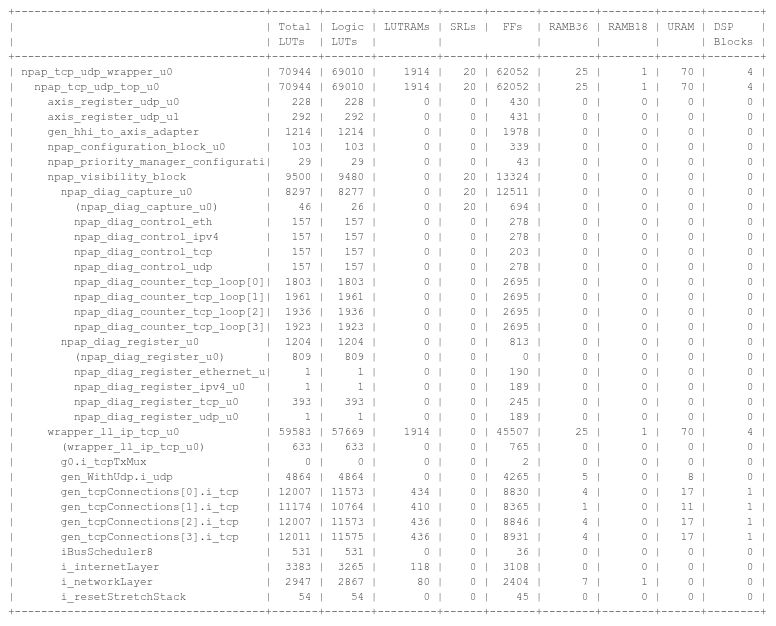
The following table shows resources for AMD/Xilinx Versal AI Edge Series fabric (xcve2302-sfva784-1LP-e-S-es1) compiled with AMD/Xilinx Vivado/Vitis 2024.1 – instantiating the following design features:
- Ethernet block
- IPv4 block
- 1 UDP block
- 4 instances of TCP blocks
- Diagnostics blocks
MLE NPAP for AMD/Xilinx Ultrascale+ Series
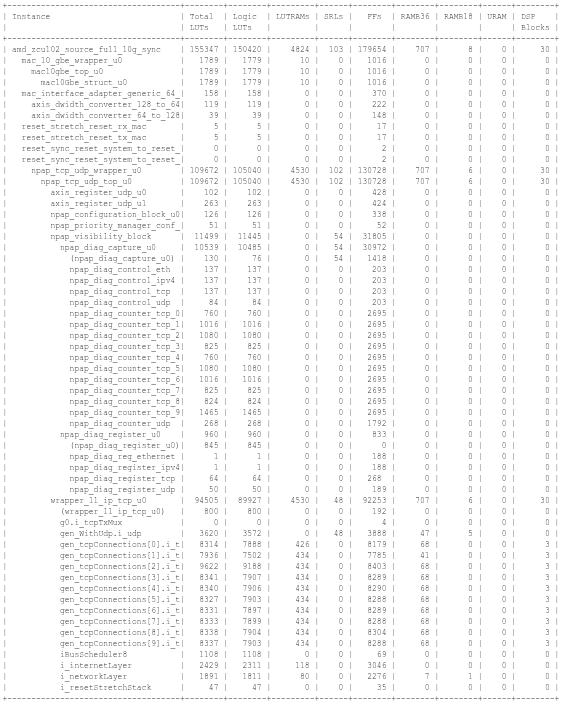
The following table shows resources for AMD/Xilinx Zynq Ultrascale+ MPSoC ZU9EG compiled with AMD/Xilinx Vivado 2022.2 – instantiating the following design features:
- 10 GigE Low-Latency MAC from Fraunhofer HHI
- Ethernet block
- IPv4 block
- UDP block
- 10 instances of TCP blocks (2 used for netperf)
- TCP and UDP Diagnostics blocks
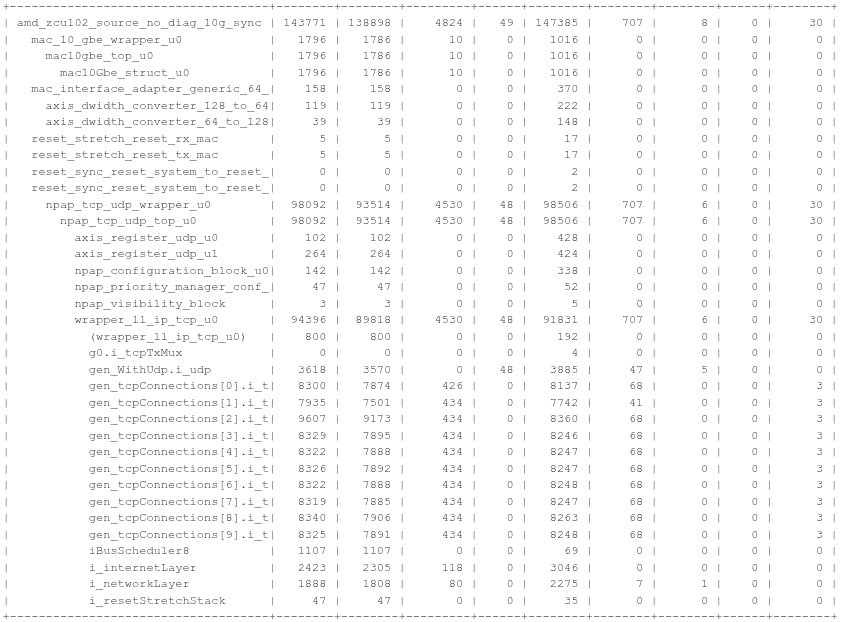
- 10 GigE Low-Latency MAC from Fraunhofer HHI
- Ethernet block
- IPv4 block
- UDP block
- 10 instances of TCP
Changelog
MLE NPAP Changelog Table of Contents MLE NPAP ChangelogMLE NPAP Version 2 DevelopmentMLE NPAP Version 1 Development The following lists MLE’s engineering changelog for MLE NPAP. With the release of NPAP v2.2.0 the development cycle has changed from 1.x to 2.x. Version 2.4.5 uses the least amount of resources and includes no diagnostics.Version 2.5.0 and onwards requires VHDL-2008. VHDL-2008 is not fully supported in Quartus Prime Standard, for example. Please inquire with any questions regarding tool support. MLE NPAP Version 2 Development 20260630 No DIag (and no VHDL-2008) TB2026xxxx Latency / RTO Hybrid TC 20260228 NPAP Kernel v2.9.0 TCP #6668 – rework handling of RTO settings #7734 – add simulation timeout to TCP transmit module to shorten establish time in simulation ERD v3.4.11 all bump ERD to v3.4.11 #6525 – fix naming by using different names for same signals #6668 – update RTO signals naming between TDA and TCA #7804 – fix psh signal connection between TDA and TCA IP update to NPAP v2.9.0 update to TDA v5.0.0 update to TCA v5.0.0 20260131 NPAP Kernel v2.8.1 GENERAL #7630 – add support for Quartus Prime Standard Edition TCP #7516 – fix data segment handling if TCP receiver is turned off #7722 – fix TcpCmdStopRecv command does not disable TCP receiver #7723 – improveProtocol Support (RFC1122)
MLE NPAP Protocol Support (RFC1122 excerpt)
MLE NPAP Ethernet Layer
| Feature | Section | Must | Must Not | Implemented |
| Send Trailers by default without negotiation | 2.3.1 | x | x | |
| ARP | 2.3.2 | |||
| Flush out-of-date ARP cache entries | 2.3.2.1 | x | (x) | |
| Prevent ARP floods | 2.3.2.1 | x | (x) | |
| Ethernet and IEEE 802 Encapsulation | 2.3.3 | |||
| Host able to: | 2.3.3 | |||
| Send & receive RFC-894 encapsulation | 2.3.3 | x | x | |
| Send K1=6 encapsulation | 2.3.3 | x | ||
| Use ARP on Ethernet and IEEE 802 nets | 2.3.3 | x | x | |
| Link layer report b’casts to IPv4 layer | 2.4 | x | ||
| IPv4 layer pass TOS to link layer | 2.4 | x | ||
| No ARP cache entry treated as Dest. Unreach. |
2.4 | x | x |
MLE NPAP IPv4 & ICMP Layer
- 1
- 2