
Linux Kernel Bypass With MLE NPAP
Increased Ethernet speeds push a need to offload CPUs from the burden of TCP/UDP/IPv4 processing. Various kernel bypass options exist, some include so-called RDMA (Remote DMA). NPAP can provide architecture choices for implementing such kernel bypasses.
Normally, from a CPU’s perspective, TCP socket I/O means sending and/or receiving (raw) network data between the host CPU and the NIC. The kernel runs network protocol processing for IPv4, TCP, and socket APIs. User space applications that generate and/or digest the network data add to the CPU processing burden.
RDMA skips most steps and a so-called rNIC (RDMA NIC) device driver directly interfaces with user space memory, effectively bypassing the kernel:
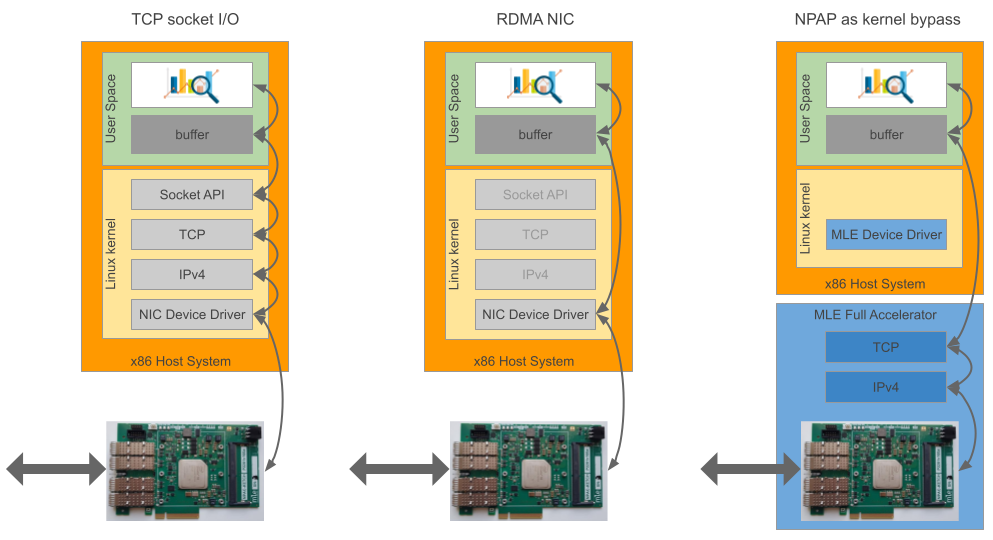
MLE NPAP can operate in a similar way, where NPAP does all TCP/IPv4 processing in dedicated ASIC / FPGA logic and then a (Linux) device driver copies the payload data between user space memory and MLE NPAP.