
High-Bandwidth Low-Latency Spinal Cord for Robots
Next generation robotic manipulation systems will be defined not only by better Physical AI algorithms, but by a better balance between centralized compute and local intelligence, and by better flexibility to partition control, communication, sensing, and local processing under real physical constraints. Control-loop execution, fault response, and synchronized behavior need “hard real-time”, while dense tactile, force, and visual sensing have very different requirements for bandwidth, buffering, and transport. For example, a humanoid joint requires torque observation, current monitoring, temperature awareness, and contact-related estimation. Therefore, solutions such as hand-mounted cameras require that high-bandwidth data streams and real-time sensing & motion control traffic can co-exist.
Approaches which separate wiring for control-critical traffic from data-rich sensor networks, however, have significant cost disadvantages and lack flexibility and scalability – a problem we see in today’s automotive in-vehicle networking. AMRs and Humanoids need something better!
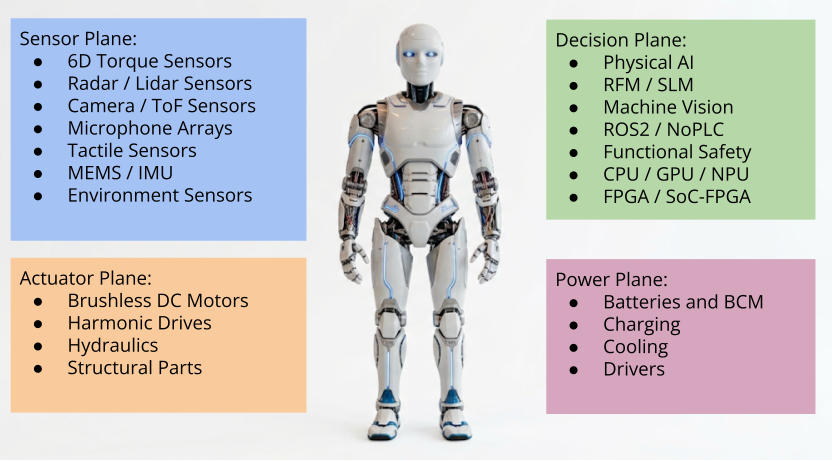
MLE’s High-Bandwidth, Low-Latency Spinal Cord for Robots converges networking for deterministic real-time control with communication, sensing, and local intelligence within a tight size, weight, power and cost envelope. delivers reliable, high-bandwidth, low-latency data transports for connectivity between Sensor Plane, Actuator Plane and Decision Plane – scalable, flexible, fast, safe, secure, always on-time and open – because MLE combines open standards with data-in-motion processing and hardware acceleration of industry-standard protocol stacks.
Features and Benefits
- Scalable from 100 Mbps to 100 Gbps
- Agnostic to physical layer, supports fiber, copper, SPE – regain control of your BoM
- Bridging and/or Tunneling of protocols like PCIe, EtherCAT, Profinet, Ethernet, GMSL, RS485, CAN, CAN-FD, CC-Link IE TSN, etc.
- Hardware accelerated real-time, deterministic transport with Ultra Low Latency less than 1 microsecond
- Reliable transports via RDMA, TCP or RRRRP over IPv4
- Scalable IPv4 addressing from individual robott to entire fleets
Converged, Bi-Directional Real-Time Connectivity
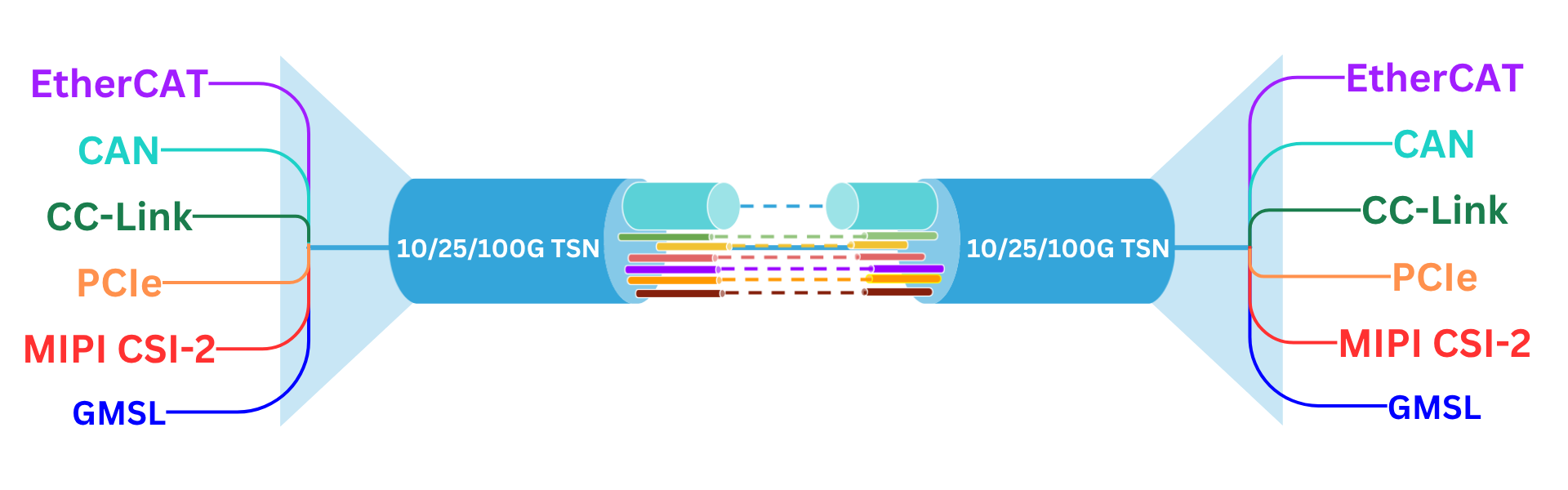
Today’s protocol software neither keeps pace with the arrays of high-bandwidth sensors, nor with the hard real-time constraints for the motion control. By accelerating these slow software protocol stacks, MLE removes complex data-in-motion bottlenecks with deterministic, ultra-low-latency hardware pipelines where latency and jitter is measured in nanoseconds. Tunneling, the concept of transporting one protocol over another protocol, adds a layer of network virtualization and, thereby, a layer of functional safety and security. Many different communication protocols can be transported over the same physical wire!
Based on the ubiquitous IPv4, the space for addressing nodes is 32 bits wide – which allows to scale networking from within a robot to entire robot fleets. All is “software-defined” and can run over many different physical links, from fiber to copper to Single-Pair Ethernet (SPE): When needed for disaggregation, or for integrating communication and sensing (ICAS).
Supported Protocols
IT Standards Supported
- PCI Express 3.1, or newer
- MIPI CSI-2, or newer
- IEEE 802.3bw for 100 Mbps (100BASE-T1)
- IEEE 802.3bp for 1 GigE (1000BASE-T1)
- IEEE 802.3ch for 2.5/5/10 GigE automotive
- IEEE 802.3ae for 10 GigE over fiber
- IEEE 802.3an for 10 GigE over twisted-pair copper (10GBASE-T)
- IEEE 802.3by for 25 GigE
- IEEE 802.3cd for 50 GigE (using PAM4)
- IEEE802.3ba for 100 GigE (10×10 Gbps)
- IEEE 802.3bm for 100 GigE (4×25 Gbps)
- IEEE 802.3ck for 100 GigE (single lane)
- IETF Internet Protocol IPv4
- Reliable transports via IETF TCP/IP and/or Quad-RP/IP
OT Standards Supported
- IEC 61158 / IEC 61784 EtherCAT
- IEC 61158 / IEC 61784 ProfiNET
- CC-Link IE TSN (CLPA)
- CIA301 CANopen
- IEC 61131-3 PLC and/or NoPLC
Security Standards Supported
- NIST 800-193, NIST PQC
- National Security Agency CNSA 2.0
- Trusted Computing Group (TCG) DICE
- FIPS 203 ML-KEM Key-Encapsulation Mechanism
- FIPS 204 ML-DSA Digital Signatures
- FIPS 205 SPHINCS+ Hash-Based Digital Signature
- IEEE 802.1AE-2018 MACsec
- IETF RFC 8446 TLS 1.3
Time Synchronization
- IEEE 1588v2 Precision Time Protocol (PTP)
- IEEE 802.1AS Time-Sensitive Networking (TSN) Time Synchronization
- IEEE 1588-2019 (HA Profile) Precision Time Synchronization (a.k.a. CERN White Rabbit), or MLE “Light Rabbit”
Frequently Asked Questions
What are the critical requirements for robotic connectivity?
Modern robotic connectivity functions as the machine’s nervous system, requiring three essential capabilities:
Real-Time, Low-Latency Control: Sub-microsecond timing and ultra-low jitter are essential for dynamic balancing, high-speed joint coordination, and closed-loop motor reflexes.
High-Bandwidth Sensor Ingest: Multi-gigabit throughput (10G+) to stream raw, uncompressed vision and sensor data directly to Physical AI compute without processing delays or frame drops.
Harness Simplification: Converging disparate protocols onto a single physical backbone (such as deterministic Ethernet) to eliminate bulky cable bundles, prevent mechanical wear at articulating joints, and cut payload weight.
What is a Converged Robot Connection or "Robot's Spinal Cord" in robotics networking?
A robot’s spinal cord is a single converged network fabric that carries hard real-time control traffic, high-bandwidth sensor streams, and system communication between a robot’s Sensor Plane, Actuator Plane, and Decision Plane — replacing separate wiring harnesses for each traffic class. MLE implements this in cost-optimized FPGA technology.
How do humanoid robots run motion control and camera data on the same wire?
By tunneling: one protocol is transported inside another, adding network virtualization and a layer of functional safety and security. MLE tunnels protocols like EtherCAT, PCIe, GMSL, CAN-FD, and MIPI CSI-2 over shared physical links so a hand-mounted camera and a joint’s torque loop coexist without the camera’s bandwidth disturbing control determinism.
What latency does MLE's hardware-accelerated transport achieve?
Less than 1 microsecond, with jitter measured in nanoseconds, because protocol stacks are accelerated in FPGA hardware pipelines rather than executed in software.
Why not just use separate networks/cables for robot control and sensing?
Separate harnesses raise cost, weight, and cabling complexity, and they limit flexibility and scalability — the same problem the automotive industry faces with in-vehicle networking. AMRs and humanoids operate under tighter size, weight, power, and cost (SWaP-C) budgets, which makes convergence necessary.
Which industrial and automotive standards does MLE support?
PCIe 3.1+, MIPI CSI-2, IPv4/TCP, IEEE 802.3bw/bp/ch/ae/an/by/cd/ba/bm/ck Ethernet variants, EtherCAT, PROFINET (IEC 61158/61784), CC-Link IE TSN, CANopen CIA301, and IEC 61131-3 PLC/NoPLC.
Why does MLE use IPv4 addressing inside a robot?
IPv4 gives a 32-bit address space — roughly 4.3 billion addressable nodes — so the same addressing scheme covers every sensor, actuator, and compute node inside a single robot and continues to work unchanged across an entire robot fleet. There is no protocol boundary or gateway translation between intra-robot networking and fleet-level networking: a joint controller, a hand-mounted camera, and a fleet management server all sit in one addressable namespace. Because IPv4 is ubiquitous in IT infrastructure, standard tooling, routing, and diagnostics apply directly to the robot’s internal network.
What physical layers can MLE's robot networking fabric run over?
The fabric is software-defined and physical-layer agnostic, running over fiber, twisted-pair copper, or Single-Pair Ethernet (SPE). SPE matters for robotics because a single twisted pair reduces cable weight and connector size inside arms, joints, and torsos — critical under tight size, weight, power, and cost budgets. This flexibility supports two architectural patterns: disaggregation, where compute and sensing are physically separated and linked over the network, and Integrated Communication and Sensing (ICAS), where sensor data and control traffic share the same link.
How does an FPGA implementation keep a robot's network future-proof?
Implemented in modern, cost-optimized FPGA technology, MLE provides an extensible platform to accommodate changes over the life-cycle and to support the many industry protocols, even EOL’ed or in-house protocols.