
Presentation at the Storage Developers Conference (SDC) 2026 of SNIA, Santa Clara, CA, Sep 30, 2026
At SDC 2023 and SDC 2024, we presented Homa, a reliable datacenter transport-layer protocol invented by John Ousterhout at Stanford University. We were able to demonstrate that Homa and TCP can co-exist in the same network “peacefully”, and how Homa can be accelerated by something similar to what Offload Engines do for TCP.
Today, (almost) everybody’s eyes are on datacenter infrastructure and AI clusters because of the challenging Terabit line rates and the high volume numbers of network ports. Nevertheless, there are many other applications which can also benefit from Homa:
- Systems-of-systems such as zone-based automotive networks
- Telecommunication core networks
- Converged IT/OT networks in industrial automation
- Backbones in humanoid robots
- Sensor Open Systems Architectures in aerospace & defense
These systems need a reliable transport-layer protocol which minimizes tail latency and optimizes infrastructure efficiency to deliver bandwidths of 10 Gbps, and more.
Many of these systems require hard real-time behavior which – in theory – matches with Homa’s attributes of being:
- message-based
- connection-less
- using receiver-driven congestion control
- run-to-completion (SRPT)
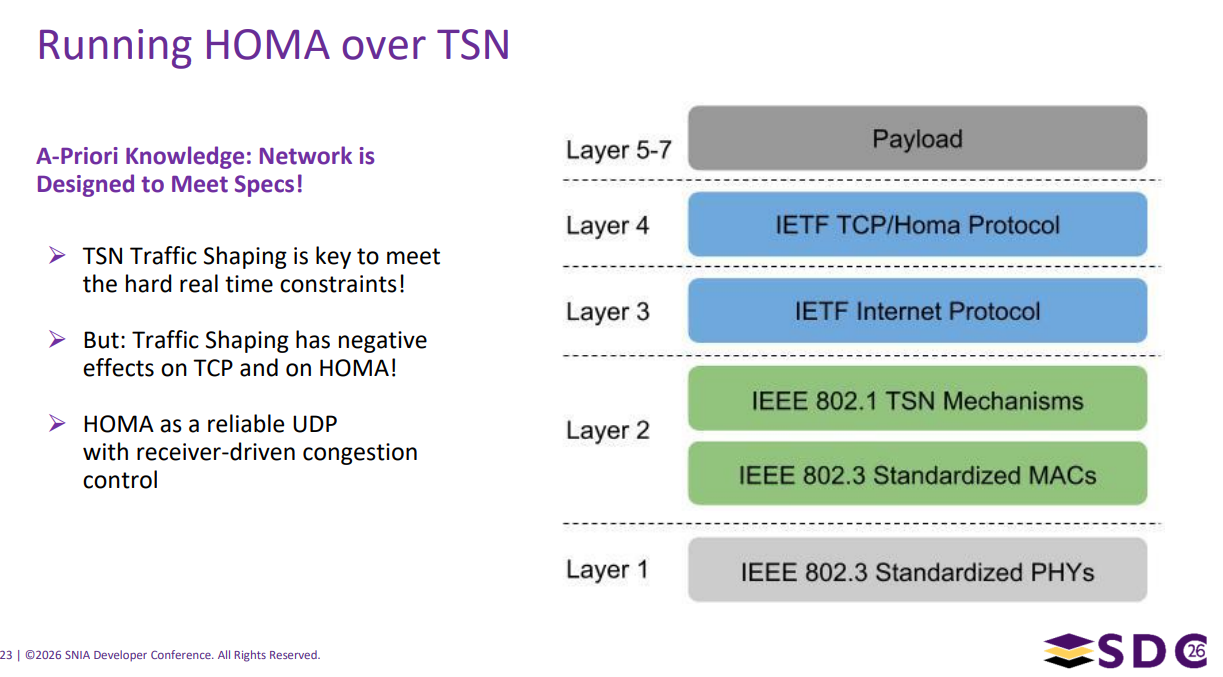
Time Sensitive Networking (TSN) has become the de-facto choice using IEEE standard Ethernet. TSN comes with time-synchronization, traffic shaping, reliability and resource management and works well with higher-layer protocols such as TCP.
Hence, in our presentation this year we shared insights on how Homa can be run over TSN and, in particular, the effects of different forms of traffic shaping on Homa’s core functions. We started with a refresher on Homa and then dived into architecture choices when running TSN and multiple Gbps. This was complemented by presenting “Light Rabbit” which is a cost-optimized variant of CERN’s White Rabbit high-accuracy time synchroniz
To learn more about the details, download the slides below or contact us for more information.